
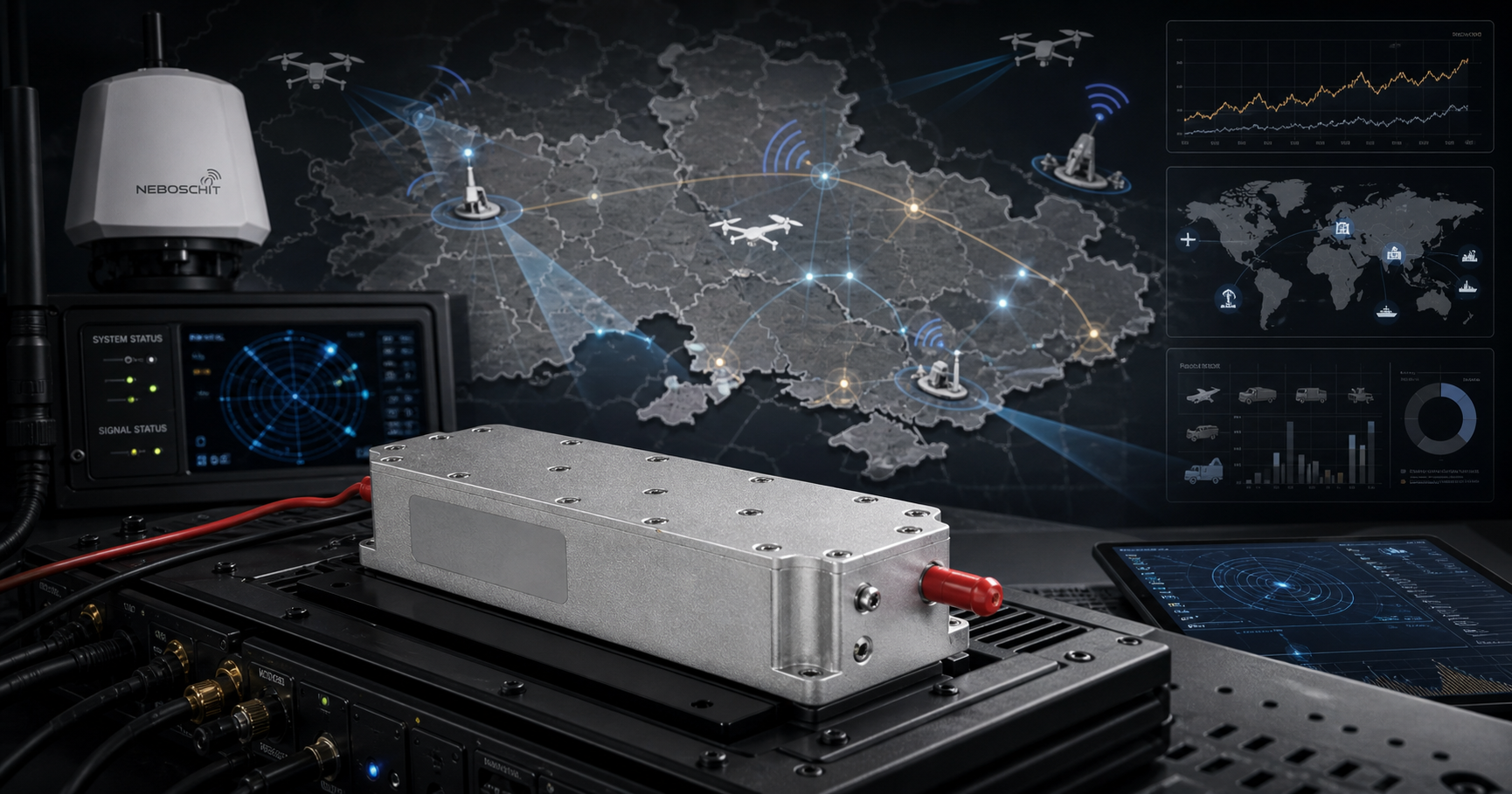
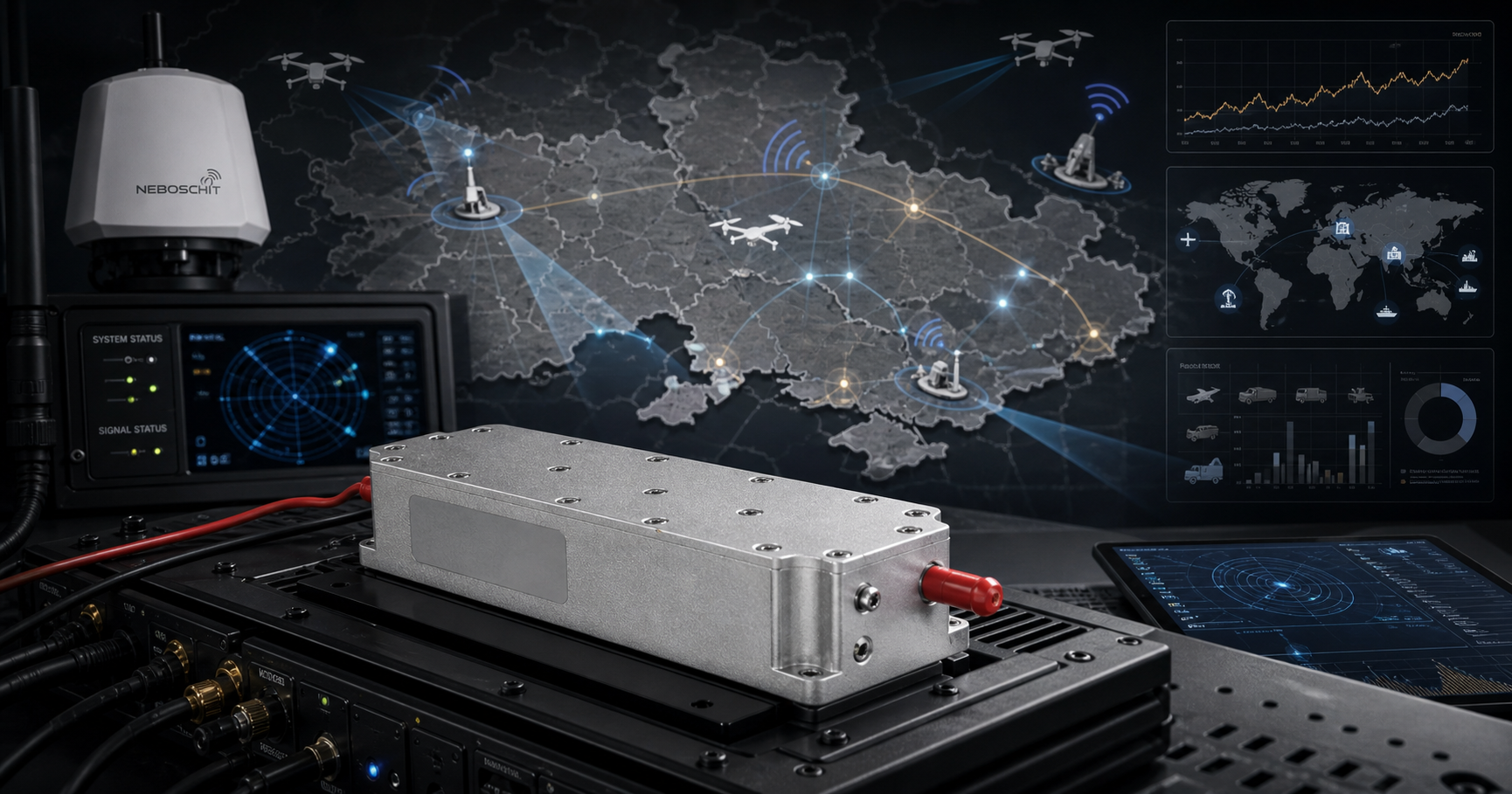
The widespread use of low-cost drones in the Russia-Ukraine conflict has permanently changed how governments, militaries, and civil infrastructure operators think about drone threats.
Introduction: A Conflict That Changed Everything
Before February 2022, counter-drone technology was largely seen as a specialized military capability -expensive, complex, and relevant only to advanced defense forces. The Russia-Ukraine conflict dismantled that assumption within the first six months.
What the conflict demonstrated, unambiguously, was that:
- Low-cost commercial drones (including modified consumer products) could be weaponized at scale
- RF jamming remained one of the most effective, fastest-deployable countermeasures
- GaN-based high-power RF modules provided the performance needed to counter drones across multiple frequency bands simultaneously
- The asymmetry of cost -a $500 drone threatening a $50 million asset -made C-UAS investment economically rational even for civil infrastructure
The aftershocks of this reality are now visible in procurement decisions, exhibition agendas, and policy frameworks from Brussels to Tokyo.
Part 1: What the Conflict Demonstrated Technically
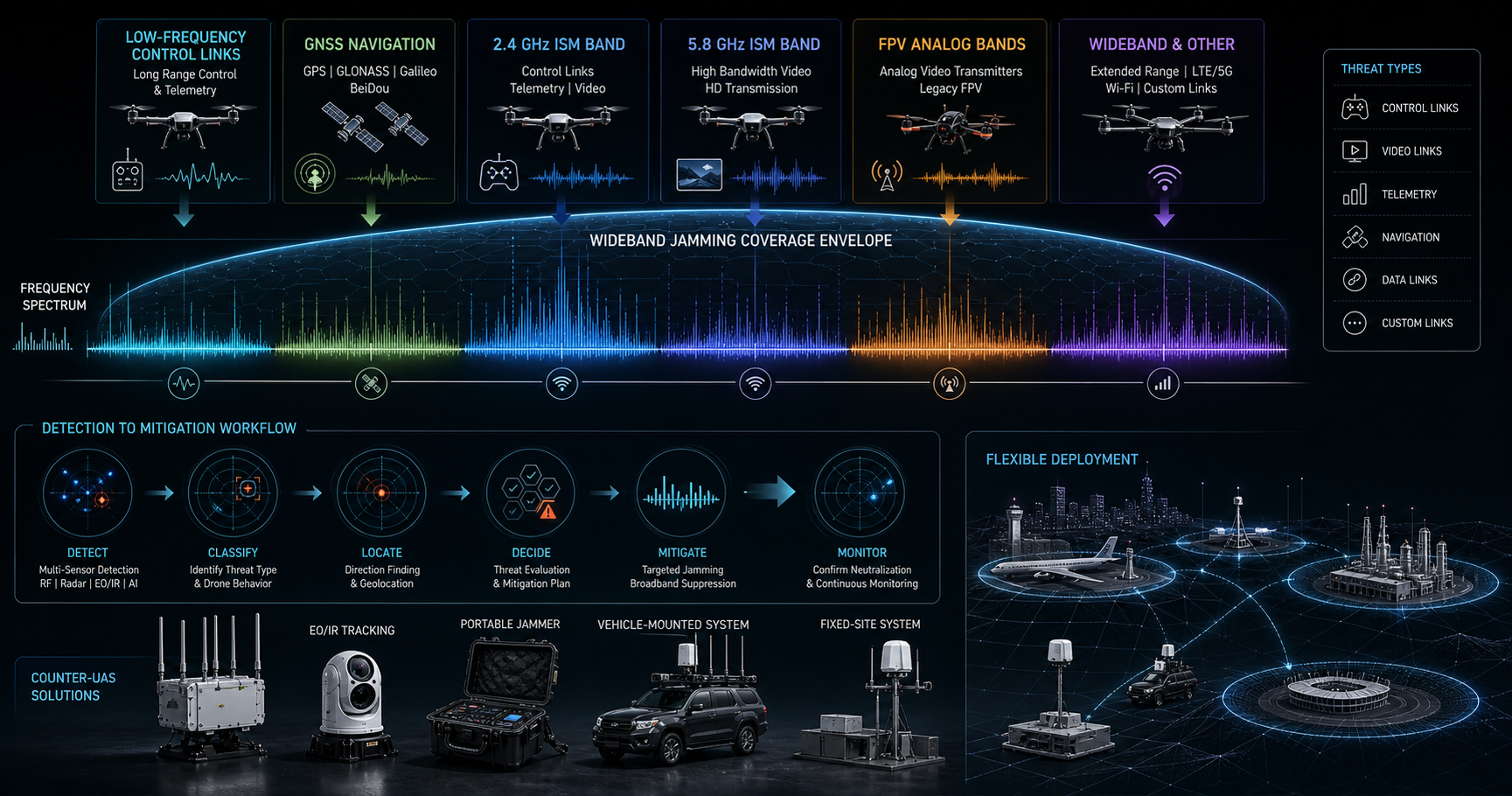
Commercial drones primarily operate across 433MHz, 900MHz, 2.4GHz, and 5.8GHz -all within the effective range of modern GaN RF jamming modules.
The Drone Categories That Changed the Calculus
Three categories of drone use emerged from the conflict with direct implications for civil C-UAS markets:
1. Commercial off-the-shelf (COTS) drones for reconnaissance
DJI Mavic and similar platforms were used extensively for target spotting. These operate on standard consumer frequencies (2.4GHz / 5.8GHz video links, GPS guidance) -the same frequencies used by hobbyist drones that threaten airports and public events.
Implication: Civil C-UAS systems originally designed for airport security are technically effective against military-grade COTS drones. The technology overlap is near-complete.
2. FPV kamikaze drones
First-person view racing drones repurposed as loitering munitions. These often use analog video links on non-standard frequencies, requiring wideband RF coverage to jam effectively.
Implication: Narrow-band jamming is insufficient. Effective C-UAS must cover 380MHz-5.8GHz with high output power across the full range -exactly what GaN-based modules enable.
3. Electronic warfare and GPS spoofing
Both sides deployed GPS spoofing to disrupt drone navigation. This accelerated interest in GNSS-independent guidance and, conversely, in GNSS spoofing as a C-UAS technique.
Implication: Multi-mode jamming (RF + GNSS) is increasingly the baseline expectation for credible C-UAS systems.
Part 2: The Global Procurement Response
Europe: From Awareness to Mandate
The conflict created an immediate sense of urgency across NATO member states and EU countries. Defense budgets increased, and C-UAS moved from "nice to have" to essential line items.
Key indicators from major exhibitions:
- Counter UAS Technology Europe (London, 2024-2025): Attendance grew significantly; procurement teams from Poland, Baltic states, Romania, and Czech Republic -all frontline NATO nations -participated formally for the first time
- Eurosatory (Paris, 2024): Counter-drone became a standalone category; French, German, and British defense ministries published C-UAS acquisition strategies
- DSEI (London, 2025): Multiple sessions dedicated to "lessons learned" from drone warfare, with direct application to civil infrastructure protection
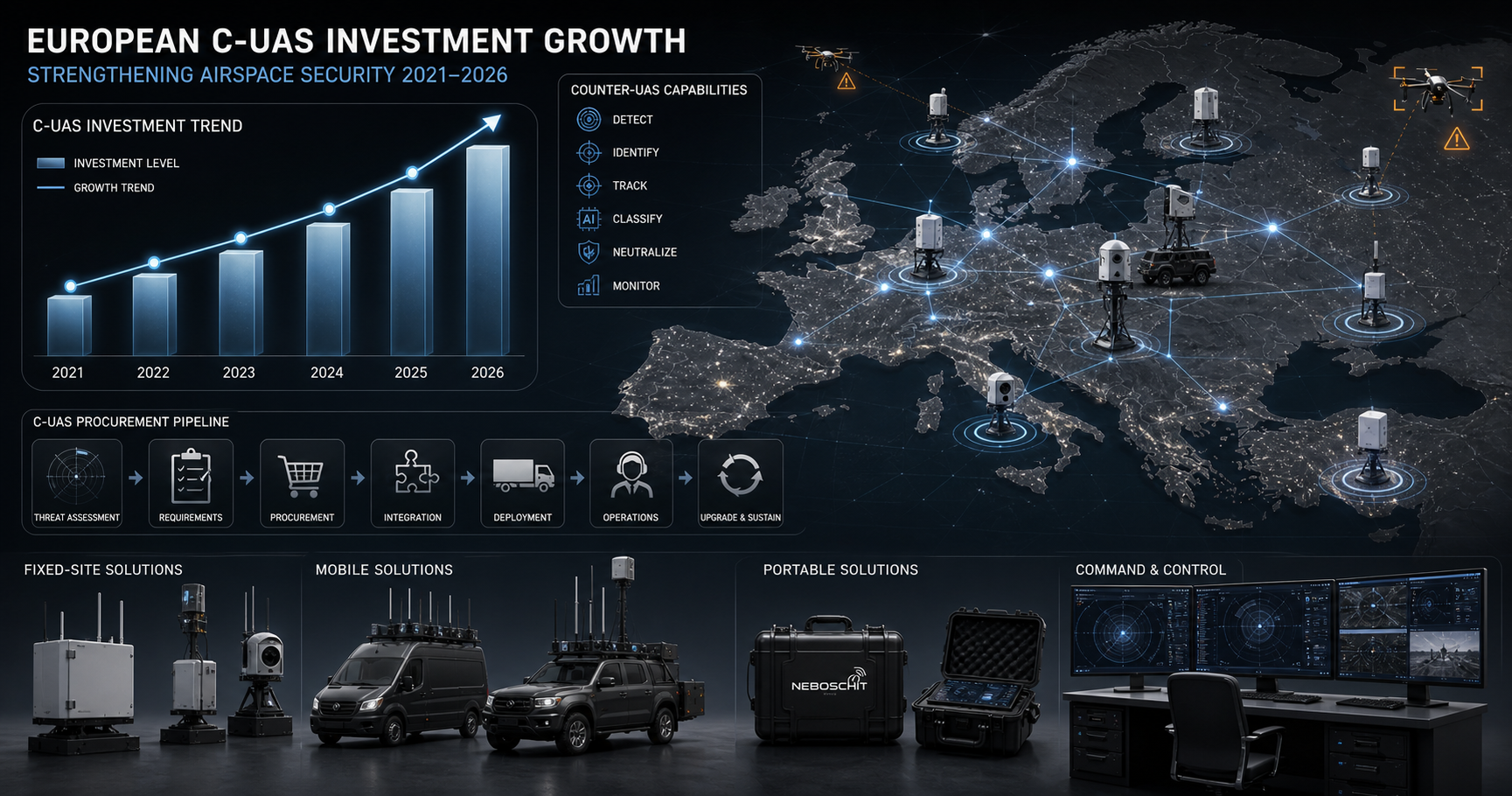
European defense budgets have increased substantially since 2022, with C-UAS as a priority procurement category.
Beyond military procurement, civilian infrastructure operators across Europe -particularly energy companies, railway operators, and airport authorities -accelerated C-UAS assessments after observing how effectively drones disrupted operations in conflict zones.
Middle East: Existing Threat, Accelerated Response
The Middle East had already experienced drone attacks on critical infrastructure before Ukraine -most notably the 2019 Aramco attacks. The conflict reinforced the urgency of existing procurement programs and triggered new ones.
At UMEX 2024 (Abu Dhabi) and IDEX 2025, C-UAS was among the most active exhibition categories. Gulf state defense ministries, energy companies, and civil aviation authorities all showed increased procurement interest.
Specific requirements that emerged:
- Long-range detection for open desert terrain
- High ambient-temperature operation (50°C+)
- Vehicle-mounted systems for mobile patrol capability
GaN modules' inherent thermal efficiency -producing less waste heat than LDMOS for equivalent output -makes them particularly well-suited to high-temperature deployment environments.
Asia-Pacific: Threat Reassessment
Japan, South Korea, Taiwan, and Australia each conducted formal reassessments of their drone threat postures following the conflict. The conclusion in each case: commercial drone threats to critical infrastructure were being systematically underestimated.
At Japan Drone 2025, civil C-UAS for infrastructure protection was a headline topic -a significant shift from prior editions focused primarily on commercial drone applications.
China's accelerated low-altitude economy development is happening in this broader context: policy makers are simultaneously enabling commercial drone use and building the regulatory and technical framework to defend against misuse.
Part 3: What Changed in Technology Specifications
The conflict produced a rapid evolution in what buyers consider minimum viable C-UAS capability.
| Specification | Pre-2022 Standard | Post-2022 Expectation |
|---|---|---|
| Frequency coverage | 2.4GHz + 5.8GHz | 380MHz-5.8GHz full band |
| Output power | 20-30W typical | 50-100W minimum for outdoor |
| Technology | LDMOS or GaN | GaN preferred / required |
| Deployment | Fixed installation | Fixed + vehicle + portable |
| Response time | Minutes | Seconds |
| Operating environment | Temperate climate | -40°C to +60°C |
This specification shift is visible in procurement documents across Europe, the Middle East, and Asia-Pacific. GaN-based RF modules -capable of delivering 50W-100W across the full 380MHz-5.8GHz range -are now the de facto technical standard for credible C-UAS RF subsystems.
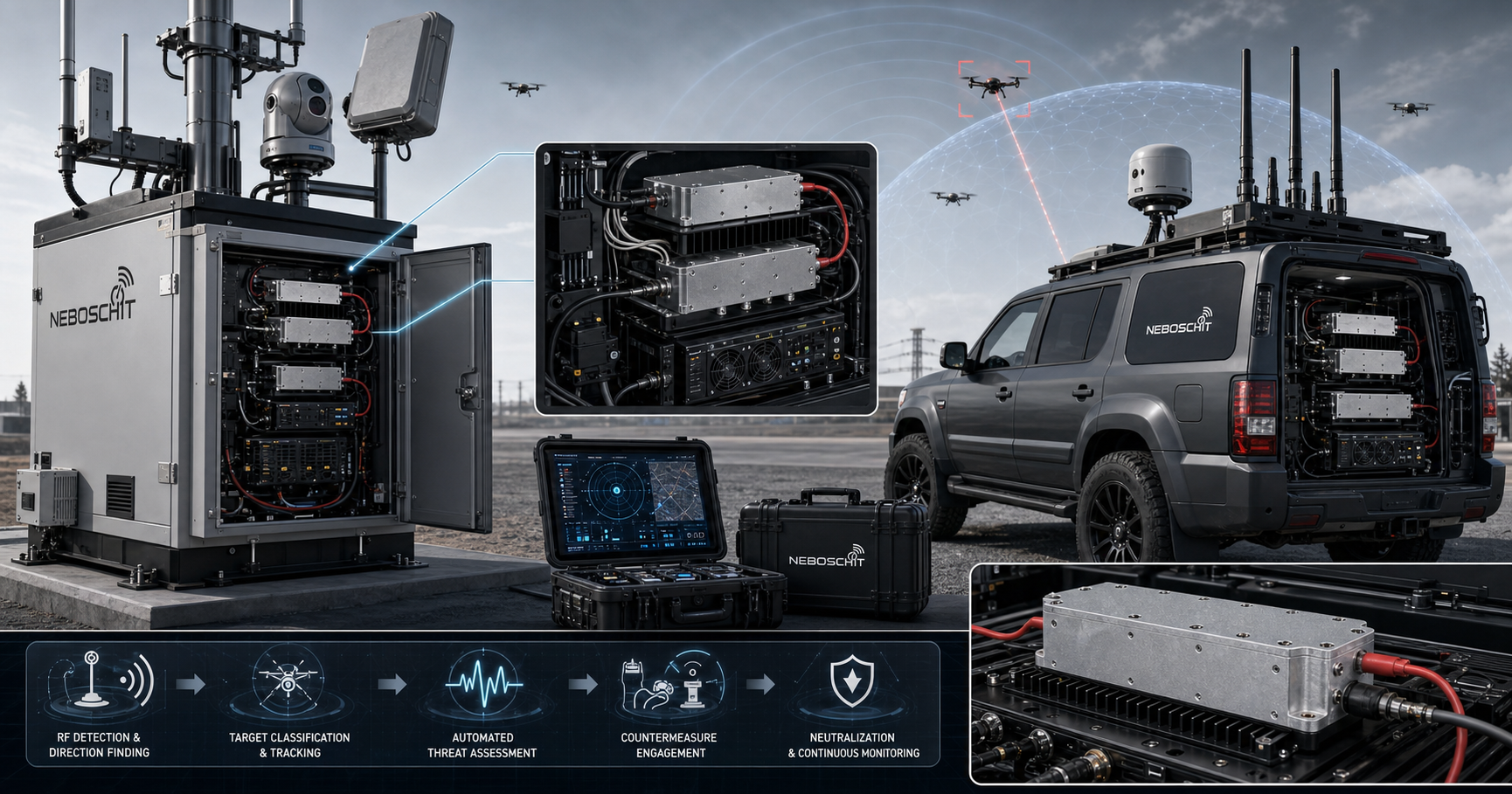
NeboShchit 100W GaN power amplifier modules cover 300MHz-5.8GHz, meeting post-2022 C-UAS specification requirements.
Part 4: Implications for System Integrators
The conflict has created a durable, multi-year procurement cycle across three distinct buyer segments:
Military and defense: Continuing to procure and upgrade C-UAS at scale; focus on multi-domain, multi-threat capability
Government and civil security: Airport authorities, border agencies, prison services, event security -all now treat C-UAS as standard security infrastructure rather than specialized capability
Critical infrastructure: Energy, utilities, transportation -newly motivated by demonstrated vulnerability; procurement often led by insurance and compliance requirements rather than internal security teams
For system integrators serving any of these segments, the key supply chain question is: where do reliable, high-performance GaN RF jamming modules come from?
Conclusion
The Russia-Ukraine conflict accelerated C-UAS adoption by at least five years. What would have been a gradual regulatory-driven market expansion became an urgent, globally synchronized procurement wave.
That wave is still moving. Governments, infrastructure operators, and security integrators across Europe, the Middle East, and Asia-Pacific are still in active procurement cycles -and the technical specifications they are using are the post-2022 standards.
NeboShchit's 50W and 100W GaN RF modules are built to those standards: 380MHz-5.8GHz coverage, -40°C to +55°C operating range, industrial reliability, and the flexibility to integrate into any C-UAS architecture.
Contact NeboShchit to discuss module specifications, integration support, and volume pricing.
Sources: NATO C-UAS assessment reports (2023), RUSI drone warfare analysis, CSIS Ukraine conflict technology assessments, Counter UAS Technology Europe 2024-2025 proceedings, UMEX 2024 exhibition notes, Japan Drone 2025 industry briefings, open-source conflict documentation