
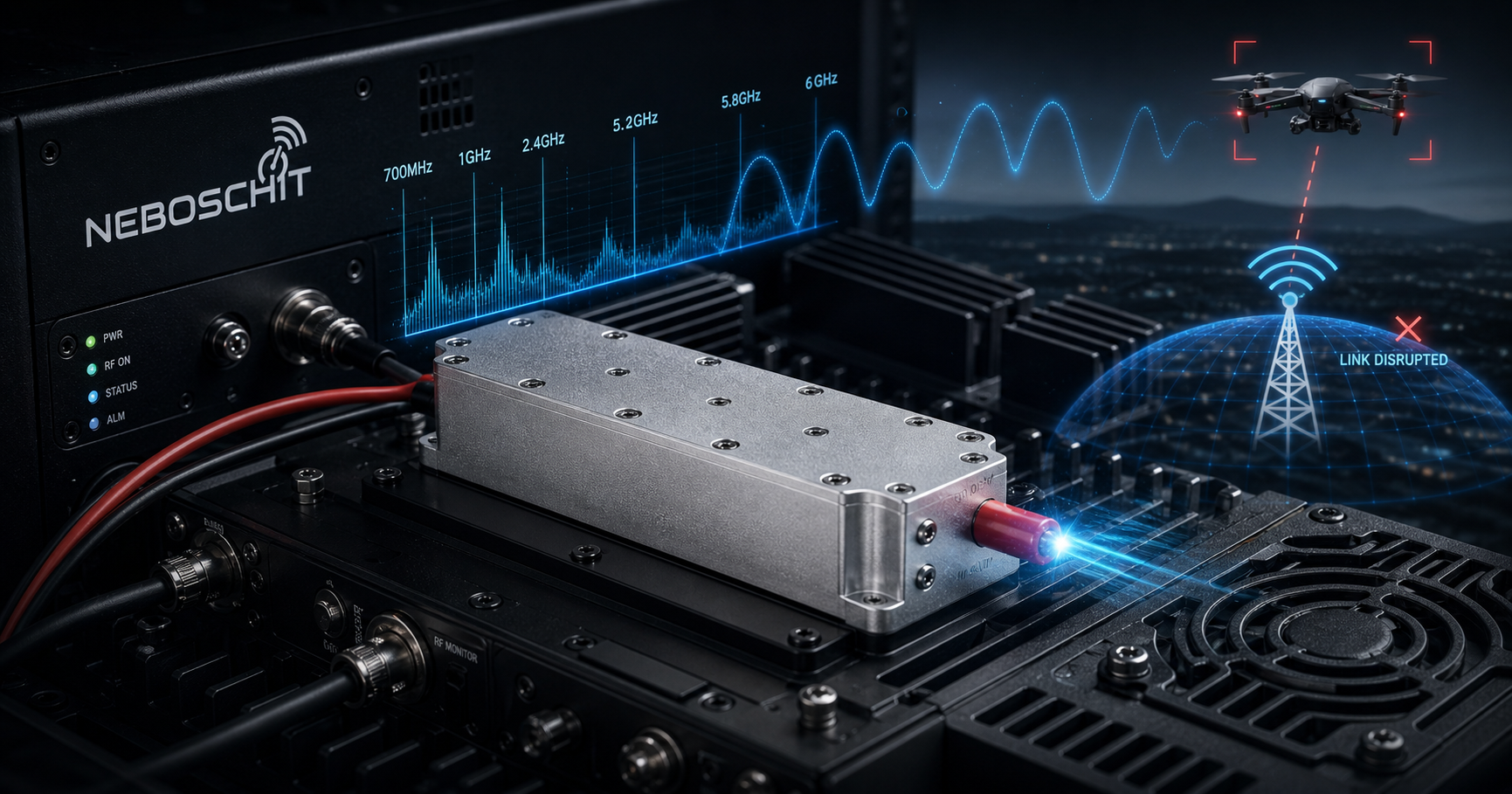
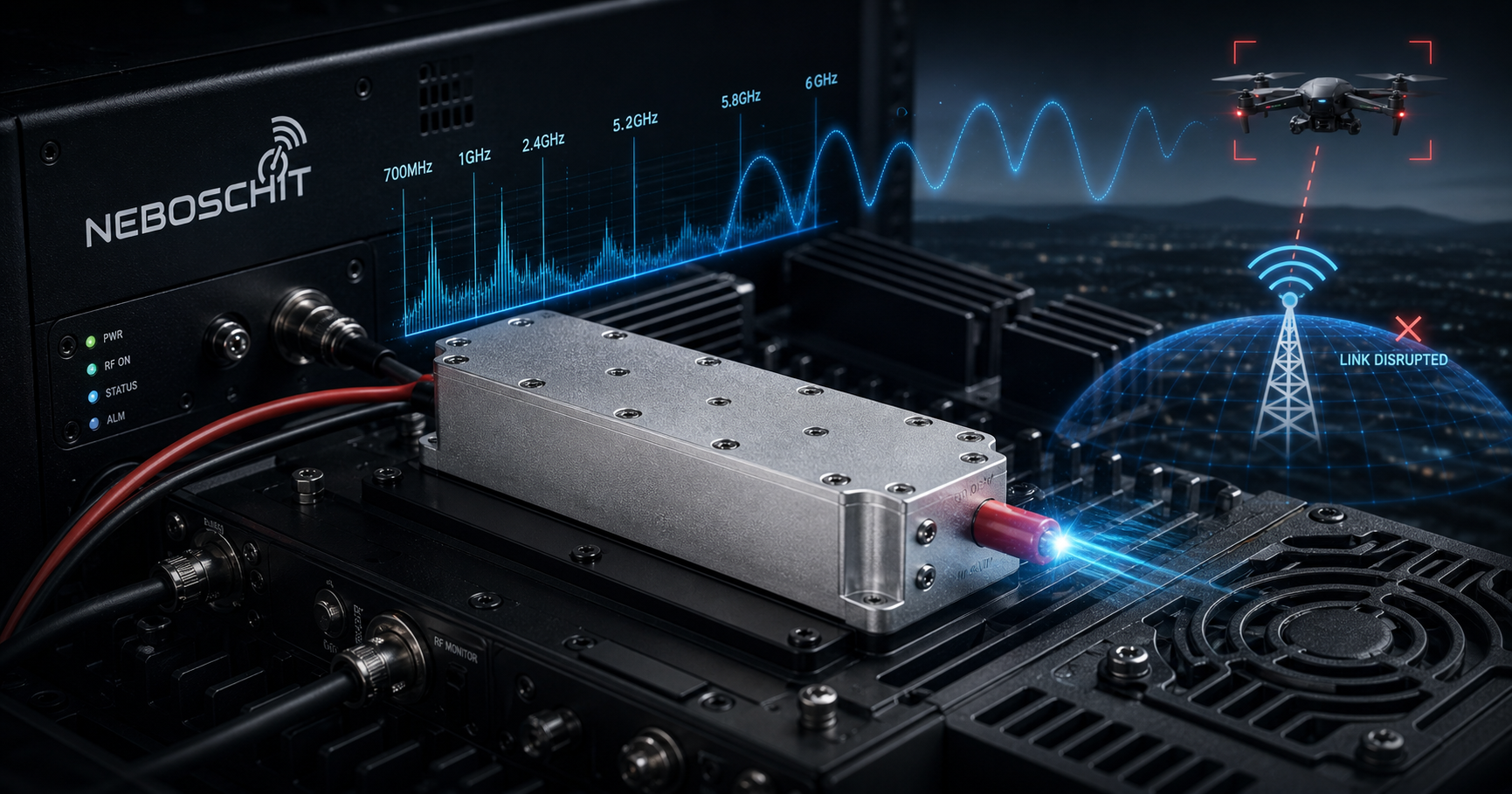
In 2022, before the Russia-Ukraine conflict made drone threats a daily operational reality, the majority of counter-drone RF jamming systems still used LDMOS (Laterally Diffused Metal-Oxide Semiconductor) power amplifier technology -the same transistor architecture that had powered cellular base stations since the 1990s. It worked well enough for the threat environment of that era.
That threat environment no longer exists.
The drones that now threaten airports, military positions, energy infrastructure, and crowded stadiums are not the same devices that motivated the first generation of counter-UAS deployments. They operate across a wider frequency range, use frequency-hopping protocols that defeat narrowband jamming, and are manufactured at price points that make mass deployment trivially accessible. Stopping them requires a fundamentally different RF performance profile -which is why GaN has become not just the preferred option, but the de facto standard for credible counter-drone jamming systems.
What Changed: The Post-2022 Threat Specification
Three categories of drones emerged from the Ukraine conflict with direct implications for C-UAS technology requirements.
Commercial off-the-shelf (COTS) reconnaissance drones -DJI Mavic and similar platforms -operate on standard consumer frequencies: 2.4GHz and 5.8GHz for video links, GPS for navigation. These are the same drones interrupting NFL playoffs and threatening airport approaches. Their frequency profile is well-understood, but their availability is essentially unlimited.
FPV kamikaze drones -racing quadcopters repurposed as loitering munitions -use analog video transmission on non-standard frequencies, often outside the 2.4/5.8GHz bands that first-generation jamming systems were built around. Narrowband systems calibrated for DJI simply don't touch these platforms.
GNSS-independent and frequency-hopping platforms represent the emerging edge. Modern drone firmware increasingly supports frequency-hopping spread spectrum (FHSS), which cycles through dozens of sub-channels to evade detection and jamming. Defeating FHSS requires high output power sustained continuously across the full spread -not bursts on a single frequency.

The procurement specification that resulted from these observations is now consistent across US, UK, EU, and Gulf state C-UAS documents: full-band coverage from 380MHz to 5.8GHz, continuous output at 50W to 100W minimum, operating range from -40°C to +60°C. LDMOS technology cannot meet this specification. GaN can.
The Physics of Why GaN Wins
The performance gap between GaN and LDMOS is rooted in semiconductor physics, not marketing.
GaN (Gallium Nitride) is a wide-bandgap semiconductor. Its electron mobility is substantially higher than silicon-based LDMOS, which means it can switch faster, sustain higher voltages, and maintain efficiency at higher frequencies. The practical outcomes of this at the component level are significant:
Power density. GaN delivers 4-6 watts per millimeter of gate width, compared to 0.5-1.5 W/mm for LDMOS. In practice, this means a GaN module producing 50W output can be physically 80% smaller than an equivalent LDMOS design -a critical advantage for vehicle-mounted and portable C-UAS systems where space and weight are constraints.
Efficiency across frequency. LDMOS performs well at frequencies below 2.7GHz but degrades sharply above that. GaN maintains high efficiency across the 100MHz-6GHz range. For a counter-drone system that needs to simultaneously cover 433MHz control links, 2.4GHz and 5.8GHz consumer bands, and GPS frequencies around 1.5GHz, this matters: a single GaN amplifier stage can cover the entire relevant spectrum. An LDMOS-based design requires multiple discrete amplifiers stacked together -adding cost, complexity, and points of failure.
Thermal performance. GaN's higher power-added efficiency (55-65% PAE versus 45-55% for LDMOS) means less waste heat per watt of output. For counter-drone applications requiring continuous 24/7 operation -airport perimeter security, border installations, fixed critical infrastructure -thermal management directly determines whether a system can run reliably without cooling infrastructure. GaN modules operating at 50W-100W output can sustain 24/7 operation in ambient temperatures up to 55°C without active liquid cooling.

GaN delivers equivalent RF output in a fraction of the physical footprint, enabling compact C-UAS deployment formats.
Real-World Validation: From Ukraine to Super Bowl LIX
The pivot toward GaN in C-UAS procurement is not theoretical -it is traceable in specific hardware deployments.
The Epirus Leonidas high-power microwave (HPM) system, now part of the US Department of Defense's counter-UAS portfolio, is built entirely on solid-state GaN semiconductor technology. In a live-fire demonstration reported in September 2025, the Leonidas system successfully neutralized all 61 drones in a single engagement -a figure that illustrates GaN's ability to sustain effective output across simultaneous, multi-target scenarios.
In March 2025, the US Marine Corps awarded Anduril a $642 million, 10-year Program of Record for counter-small-UAS systems. GaN RF technology is embedded in the jamming subsystems across this program.
RFHIC, one of the leading commercial GaN amplifier manufacturers, publishes a specific counter-drone product line covering 100MHz-6GHz at 100W CW output -explicitly targeting the C-UAS frequency specification. Multiple other commercial C-UAS manufacturers -including those supplying to the Super Bowl LIX security deployment, which intercepted over 70 unauthorized drones -have standardized on GaN power amplifier modules for their jamming subsystems.
The pattern is consistent: wherever the post-2022 C-UAS specification is being implemented seriously, GaN is the RF power technology underneath it.
What This Means for System Integrators
The practical implication for anyone designing or procuring counter-drone systems is that LDMOS-based jamming subsystems are no longer a credible option for anything beyond the most limited, fixed-frequency threat environments. The procurement community has moved on.
The questions that remain are around sourcing, integration, and total system cost:
Sourcing. GaN PA modules for C-UAS applications must cover the full 380MHz-5.8GHz range with specified power levels. Not all commercial GaN modules do this -many are designed for cellular infrastructure or radar applications with narrower frequency coverage or different linearity requirements. Counter-drone RF modules need wideband coverage optimized for continuous jamming output rather than communications linearity.
Integration. System integrators sourcing jamming subsystems are increasingly looking for modular GaN RF components rather than complete proprietary jammer units -the modular approach allows integration into existing detection architectures without a full system replacement. The ability to specify frequency coverage, power level, form factor, and interface type at the module level is the practical requirement.
MOQ and supply chain. Counter-drone deployments range from single-unit field systems to large-scale fixed installations. A supply chain that supports MOQ=1 for prototype and pilot deployments -and can scale for volume -is essential for integrators who are building product lines rather than one-off systems.
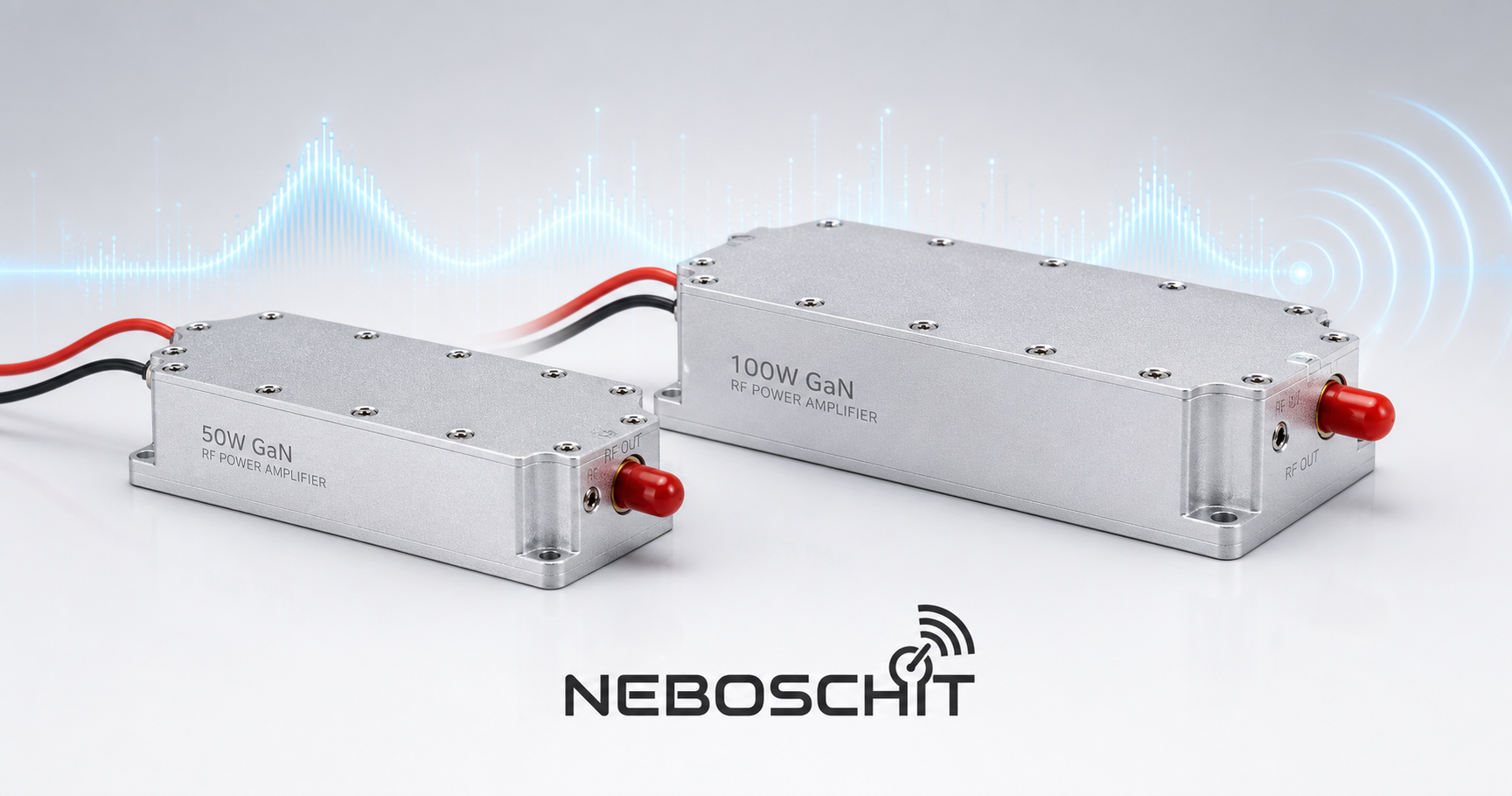
NeboShchit's GaN module range -50W (CN-GAN-50W) and 100W -covers 380MHz-5.8GHz with industrial-grade continuous output and -40°C to +55°C operating range.
The Specification Convergence Means the Window Is Now
The counter-drone market is not waiting for further validation of GaN technology. The procurement specifications are set. The programs of record are funded. The legislative frameworks -US Safer Skies Act, EU NIS2, UK C-UAS frameworks -are accelerating deployment timelines.
What is still moving is the manufacturing and supply chain capacity to support the demand. System integrators who establish reliable access to high-quality GaN C-UAS modules now are positioned ahead of a procurement wave that, based on the current legislative and incident trajectory, shows no sign of slowing.
The technology question has been answered. GaN is the standard. The remaining question is whether your supply chain is ready.
NeboShchit manufactures 50W and 100W GaN RF power amplifier modules covering 380MHz-5.8GHz, built to counter-drone specification with continuous output, industrial temperature range, and full support for custom frequency configurations. MOQ=1. Contact us to request specifications and integration support.
Sources: RFHIC -GaN Wideband Amplifiers for Counter Drone Applications · Semiconductor Today -Epirus Leonidas 61/61 Live-Fire Demo · Microwave Journal -Converting Power Amplifier from LDMOS to GaN · Military Embedded Systems -GaN PA for EW Systems · Defense Scoop -Army C-UAS Funding FY2025 · RF Wireless World -GaN vs LDMOS Technical Comparison · D-Fend Solutions -Issues with Jamming Drone Frequencies · CSIS -Russia-Ukraine Drone War Innovation