
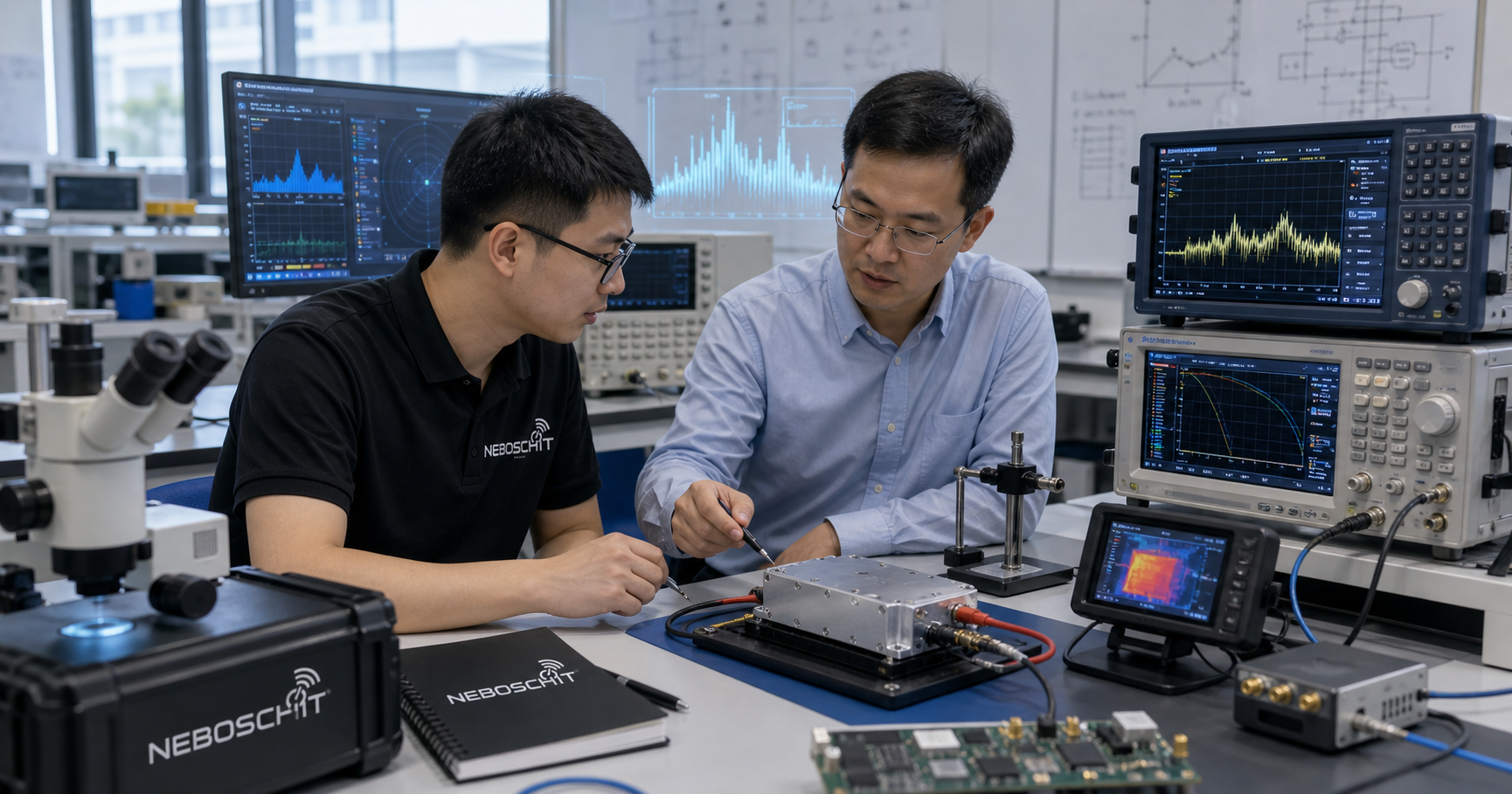
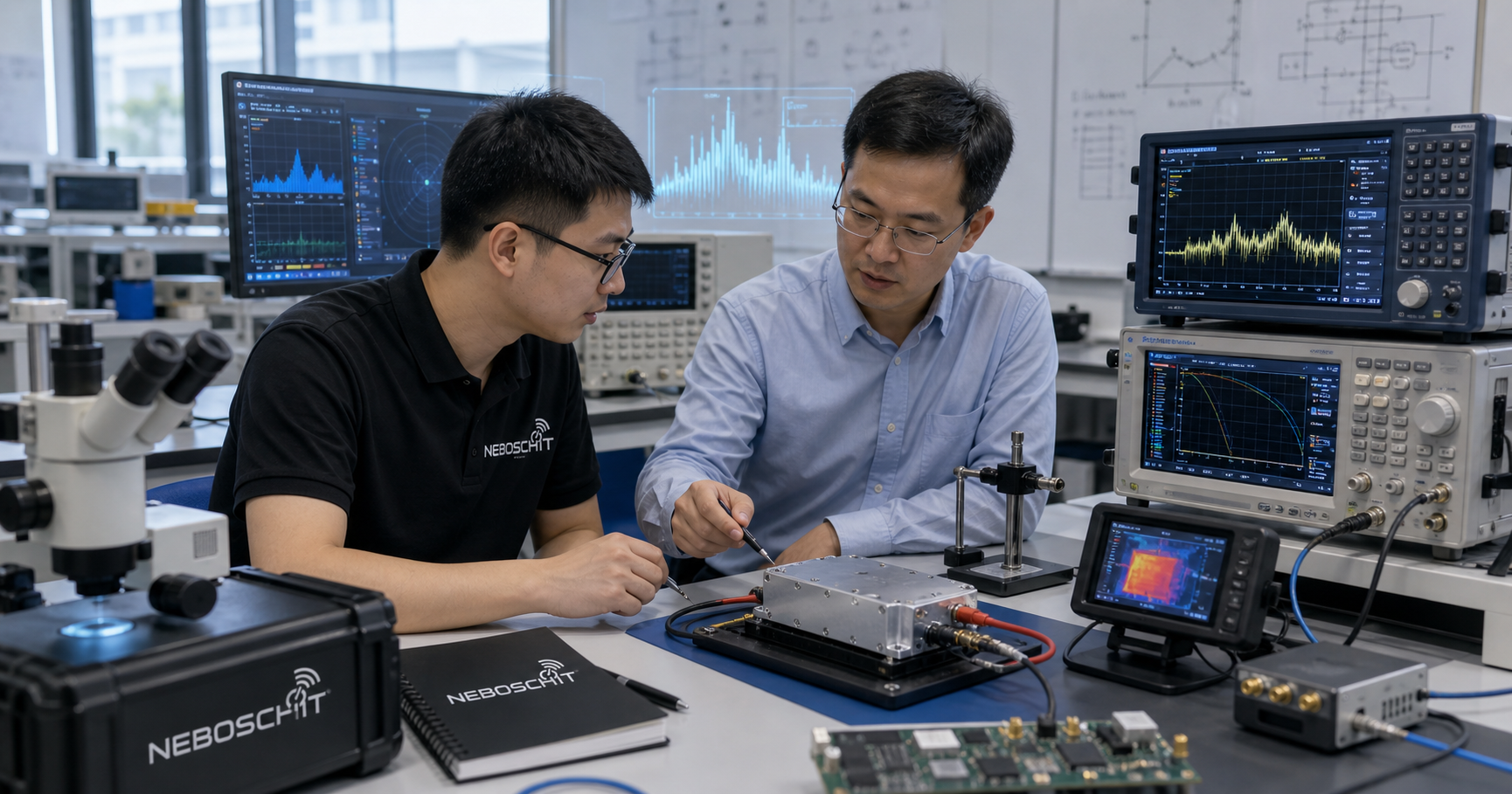
Reliable counter-drone RF performance does not emerge from component selection alone. It is built through sustained materials science research, thermal characterization under real operating conditions, and iterative design work that takes years rather than months. NeboShchit's GaN power amplifier modules are the product of that process - and a significant part of that process happens in close collaboration with university research teams in Guangdong Province.
Over the past several years, NeboShchit has established ongoing research partnerships with electronic engineering and microwave laboratories at Guangdong institutions. These collaborations are not sponsorship arrangements. They are working relationships in which our engineering team and university researchers share test data, co-develop characterization methodologies, and apply academic research directly to the performance problems that matter most in deployed counter-drone systems.
Why University Collaboration Matters for GaN Module Development

GaN-on-SiC epitaxial growth and device characterization work conducted in collaboration with Guangdong university microwave research laboratories.
GaN (Gallium Nitride) is not a mature commodity technology in the same sense as silicon MOSFET or LDMOS. The performance advantages of GaN - higher breakdown voltage, better electron mobility, superior thermal conductivity - are well-established. But translating those material properties into reliable module performance at 50W and 100W continuous output across the full 380MHz-5.8GHz C-UAS frequency range requires sustained investigation into problems that do not have off-the-shelf answers.
Several areas where academic collaboration has directly informed our module development:
Thermal characterization under sustained CW operation. Counter-drone jamming systems, unlike communications amplifiers, are required to run at full power continuously - not in burst mode. The thermal behavior of GaN devices under extended CW operation differs meaningfully from pulsed or duty-cycled operation. Our university partners' thermal modeling work has contributed directly to the heat dissipation architecture in our module designs, enabling the -40°C to +55°C operating range that our modules maintain in deployed airport and infrastructure applications.
Wideband matching network design. Covering 380MHz to 5.8GHz with a single amplifier stage requires impedance matching networks that maintain adequate gain flatness and efficiency across a 15:1 frequency range. This is a non-trivial RF engineering problem. The iterative simulation and measurement work done in collaboration with Guangdong university microwave labs has contributed to the broadband performance consistency our modules maintain across the full C-UAS frequency band.
Reliability and aging under outdoor environmental conditions. Many counter-drone deployments are outdoors, in environments with humidity, temperature cycling, and UV exposure that laboratory characterization does not naturally capture. University research into accelerated aging test methodologies, in coordination with our own qualification testing, has contributed to the reliability profile our modules demonstrate in long-term field deployments.
What the Collaboration Produces
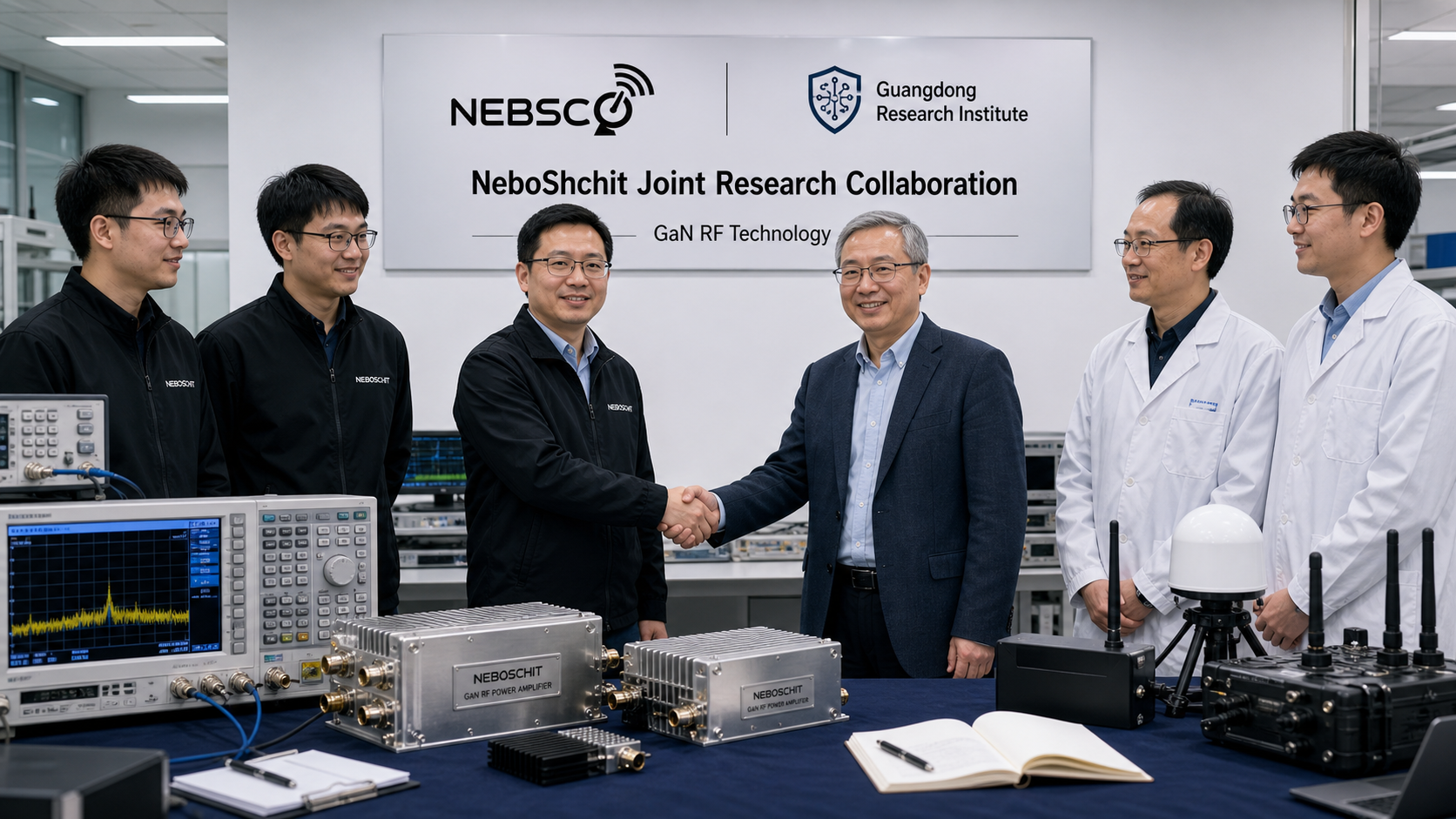
Joint measurement sessions between NeboShchit engineering staff and university laboratory teams are a regular part of our module development cycle.
The outputs of these partnerships are not academic papers alone - though those do result from the collaboration. The more direct outputs are:
- Improved thermal design in current-generation NeboShchit modules, reducing maximum channel temperature under full CW load
- Broader operating temperature certification, from -40°C to +55°C, supported by characterized thermal models rather than conservative derating
- Published frequency response and gain flatness data across the full 380MHz-5.8GHz range, generated using university laboratory calibration equipment and measurement protocols
- An ongoing pipeline of engineering graduates with direct hands-on experience with GaN RF components - several of whom have joined NeboShchit's engineering team
The collaboration also positions NeboShchit to adapt quickly as C-UAS frequency specifications evolve. New drone platforms and countermeasures are being developed rapidly; the frequency environment in 2027 will likely be meaningfully different from today's. Having active research relationships with university teams working on next-generation GaN device and amplifier design keeps our module roadmap ahead of the procurement specification curve rather than behind it.
Guangdong's Advantage for GaN Development
Guangdong Province is not an arbitrary location for this kind of collaboration. The Pearl River Delta electronics manufacturing ecosystem - centered on Shenzhen but extending throughout the province - includes the highest concentration of RF component manufacturing, PCB fabrication, and electronics assembly capability in the world. University electronic engineering programs in Guangdong are deeply embedded in this industrial ecosystem.
The proximity between academic research and manufacturing capability means that insights from laboratory characterization can move into prototype hardware quickly. Design changes that might take months to iterate in a more geographically dispersed development environment happen faster in Guangdong because the supply chain - wafers, packaging, test fixtures, assembly - is local.
This is one of the structural advantages that allows NeboShchit to offer MOQ=1 with full custom frequency configuration support. The tooling and process knowledge behind that capability is built on a foundation that includes years of academic-industrial collaboration in Guangdong.
For System Integrators: What This Means in Practice
When you source GaN RF modules from NeboShchit, you are sourcing components whose performance has been characterized through rigorous measurement processes that include independent university laboratory validation - not just factory self-certification.
That matters for counter-drone applications specifically, because the operating conditions in deployed C-UAS systems are demanding: continuous full-power output, outdoor temperature extremes, sustained operation over months and years without scheduled maintenance windows. The thermal and reliability characterization work behind our modules is the reason they meet those requirements consistently.
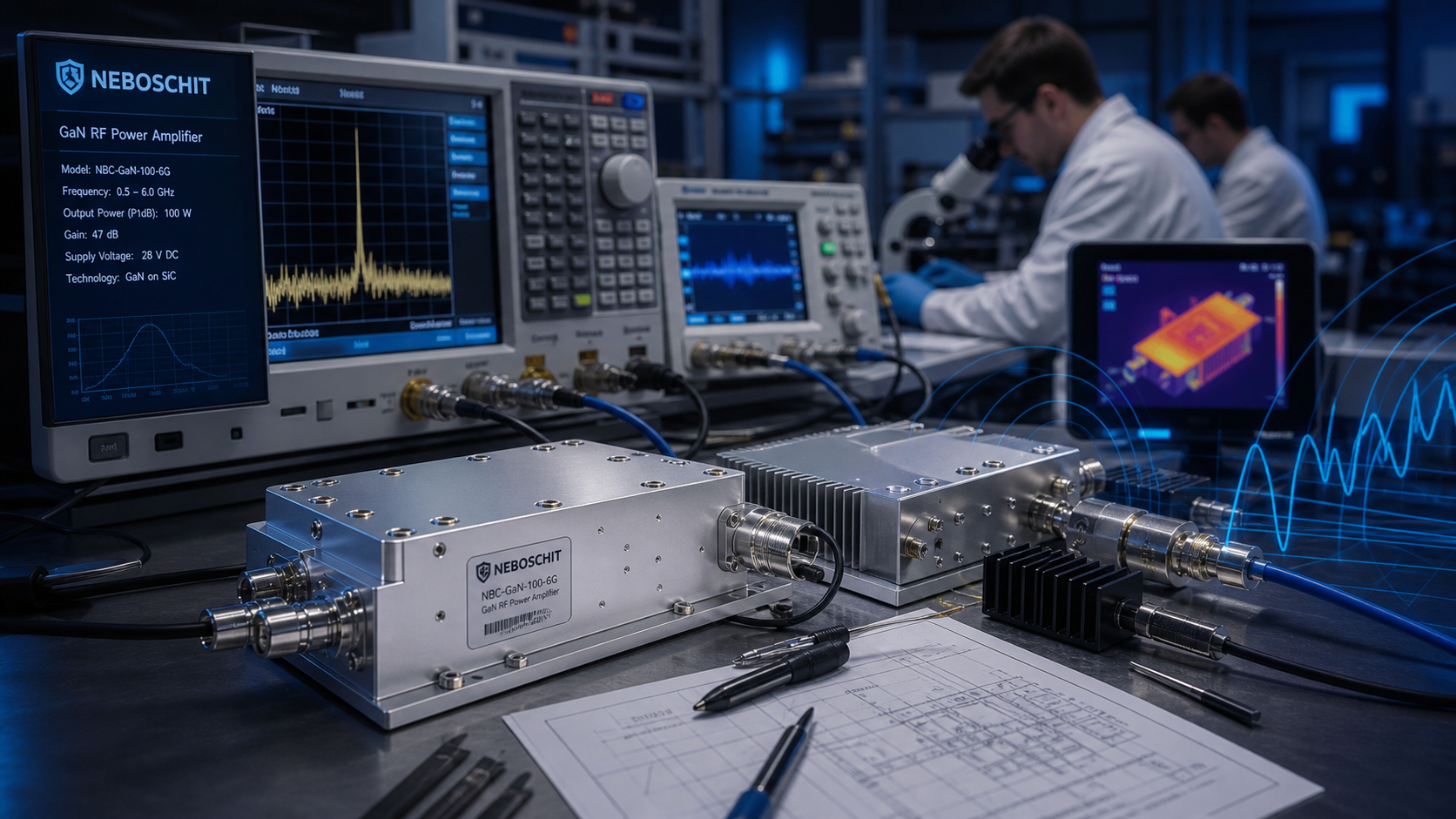
NeboShchit 50W and 100W GaN RF modules, with thermal and frequency characterization data generated through university and in-house testing.
If you are evaluating GaN RF jamming subsystems for C-UAS integration, we can provide full technical documentation including thermal characterization data, gain flatness measurements across 380MHz-5.8GHz, and operating range specifications. Contact us to request a technical datasheet.
NeboShchit maintains ongoing research collaborations with electronic engineering and microwave research laboratories at universities in Guangdong Province. Specific partnership details are disclosed under confidentiality agreements; this article describes the nature and outputs of those collaborations in general terms.